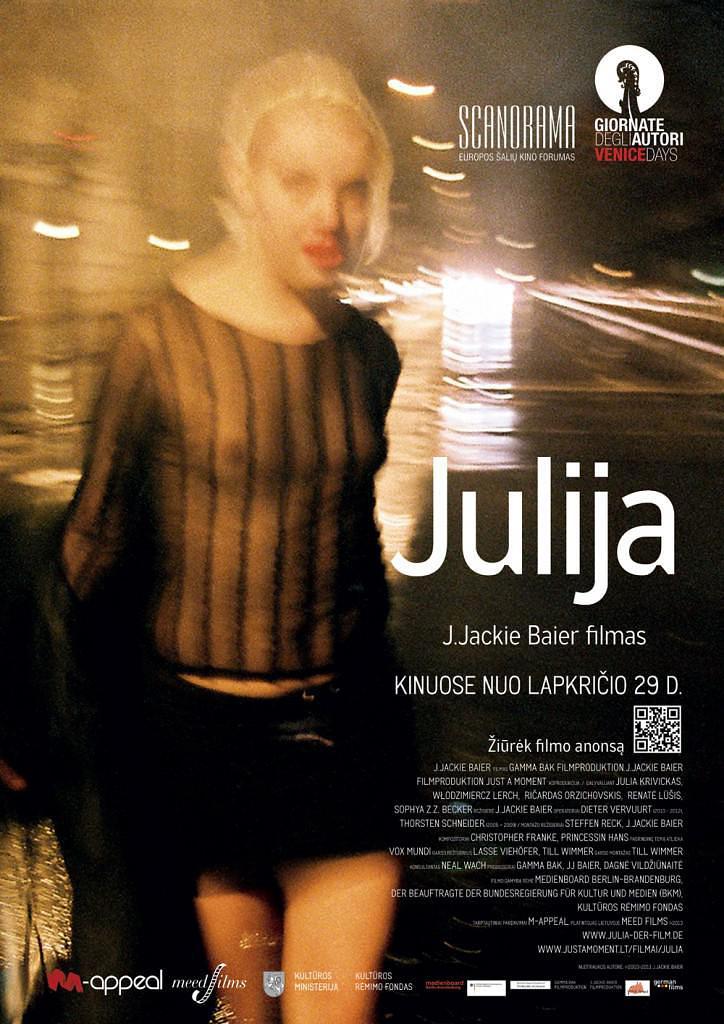
影片详情
尤利娅
A story of faith and disbelief. Of uprootedness and affiliation. What makes a boy from art school decide to leave home and live as a girl on the stree
- 类型
- 剧情片
- 年份
- 2013
- 地区
- 德国
- 语言
- 德语
- 导演
- J. Jackie Baier
- 主演
- Julia Krivickas
播放地址
《尤利娅》选集
剧情资料
剧情简介
《尤利娅》讲述的是什么故事?
《尤利娅》A story of faith and disbelief. Of uprootedness and affiliation. What makes a boy from art school decide to leave home and live as a girl on the streets of Berlin selling her body for money? For more than ten years, photographer and filmmaker J. Jackie Baier followed transsexual Julia K. from her birthplace, Klaipeda in Lithuania, to her tough life on the streets as a hooker, outlaw and nonconformist who never signed any social contract. "Julia is missing again. Yesterday I visited her in the porn cinema, in where she has crashed for the last six months. We sat in the common room of the hookers, which doubled as Julia´s bedroom; a smoky, dingy basement without any daylight, roughly the size of a prison cell, with a couch, a counter, a coffee machine and a TV, out of which some cheap television series blared at full volume. This room was what her life was limited to. She only left it when Mamsell called her for a client. I´d seen her for the very first time while she still worked at a bar in Wilmersdorf. For some time we both worked there, tempting clients with booze, offers of sex, whatever would bring in money. I soon left the business, though. The madam was simply not convinced that I was a good hooker and actually she was right - even though I learned a lot by watching Julia. Julia was soon to be out as well. She didn´t really get along in that joint. The madam had some kind of style, while Julia just had her style. It just couldn´t work. Afterwards they said that Julia was always drunk, but that can´t have been the reason, since if she had always been drunk, it probably would have worked out with the boss, who was chronically drunk herself, after all. About a year later I met Julia again. I was riding on a bus to Schöneberg, and she was at the corner of Froben-and Bülow - hustling at the strip. We drank a couple of beers at Bianca´s kiosk and she asked at some point if I wouldn´t mind taking some pictures of her again. I didn´t have my proper camera on me, just my mobile. I took some shots and once I left, promised to return. When I went back two nights later, this time with my camera, Julia had vanished. At the kiosk they said that she was dead, probably frozen to death somewhere. But then she reappeared." [J. Jackie Baier, 2006] J. Jackie Baier (b. 1955 in Kiel, Germany) received an MA in Literature at the University of Essen in 1982. She worked as assistant director on films by, among others, Peter von Zahn, Michael Lentz, and Adolf Winkelmann, and made several documentaries. In 1983 she made her feature directorial debut with Die Mission - Film vom Frieden und seinem Krieg (which premiered at the Berlinale (Forum). From 1985 to 1988 she wrote and directed two television movies for ZDF, Die Splitter der Eisbombe and Frühstück für Feinde. She has directed TV series since 1995. She had a sex change in 1997; Johanna Jackie Baier was officially a woman. She started to experiment extensively with photography and has exhibited her work at national and international art fairs. In 2006, she presented a selection of photographs and a short film as part of the group show SEX WORK (Neue Gesellschaft für bildende Kunst, Berlin). In 2011 Baier´s feature-length documentary House of Shame premiered at the 61st Berlin International Film Festival. 2013 Julia (doc) 2011 House of Shame: Chantal All Night Long (doc) 1988 Frühstück Für Feinde 1984/85 Die Splitter Der Eisbombe 1983 Die Mission - Film vom Frieden und seinem Krieg
一、《尤利娅》是哪一年上映的?
《尤利娅》是J. Jackie Baier于2013年拍摄的一部经典剧情片。此片开创德国当代剧情片的先河,《尤利娅》上映时票房稳坐前三,创下当年纪录。当时Julia Krivickas均为最佳主角,Julia Krivickas以精彩演技和突出形象,奠定在德国影坛地位。Julia Krivickas饰演角色造型多年后仍为人所模仿。J. Jackie Baier之前曾被人怀疑其能力,而《尤利娅》却奠定J. Jackie Baier剧情片风格。《尤利娅》首映时曾获海外剧情片和媒体广泛称誉,被认为其优秀程度,是足以与同时期(指2013年代)德国优秀剧情片齐名。
二、被称为剧情片的开先河之作的《尤利娅》,是J. Jackie Baier最好的作品吗?
从J. Jackie Baier斩获剧情片最佳导演开始,很多观众就觉得这部《尤利娅》是他极具代表性的剧情片。虽然J. Jackie Baier后来还拍出过评价很好的作品,但是《尤利娅》依然常被认为是他剧情片创作中的重要代表。
三、《尤利娅》为什么可以成为经典?
提起德国,不少观众都会想到《尤利娅》的名字。这部由J. Jackie Baier导演,Julia Krivickas主演的《尤利娅》,在当时凭借鲜明的人物塑造和紧凑的剧情片叙事获得了不错反响。正是人物命运、情绪推进和故事节奏之间的相互配合,让《尤利娅》在同类型作品中具有较高辨识度,也让观众对其中的情节留下深刻印象。
四、如何评价《尤利娅》?
《尤利娅》口碑表现稳定,深受广大观众喜爱。不仅Julia Krivickas的表演有看点,而且该剧情片故事情节紧凑,星辰影院(yongtai-dichan.com)观看起来流畅,同时还能保持较强的剧情吸引力。虽然不同观众对《尤利娅》的评价各有侧重,但该片目前的受欢迎程度已经名列同类作品前茅。
五、《尤利娅》剧情片的主要内容
《尤利娅》是一部剧情片作品,由导演J. Jackie Baier执导,Julia Krivickas主演。影片围绕主要人物的经历展开,通过人物关系、情节推进和情绪变化,呈现出一段具有观看价值的剧情片故事。
《尤利娅》A story of faith and disbelief. Of uprootedness and affiliation. What makes a boy from art school decide to leave home and live as a girl on the streets of Berlin selling her body for money? For more than ten years, photographer and filmmaker J. Jackie Baier followed transsexual Julia K. from her birthplace, Klaipeda in Lithuania, to her tough life on the streets as a hooker, outlaw and nonconformist who never signed any social contract. "Julia is missing again. Yesterday I visited her in the porn cinema, in where she has crashed for the last six months. We sat in the common room of the hookers, which doubled as Julia´s bedroom; a smoky, dingy basement without any daylight, roughly the size of a prison cell, with a couch, a counter, a coffee machine and a TV, out of which some cheap television series blared at full volume. This room was what her life was limited to. She only left it when Mamsell called her for a client. I´d seen her for the very first time while she still worked at a bar in Wilmersdorf. For some time we both worked there, tempting clients with booze, offers of sex, whatever would bring in money. I soon left the business, though. The madam was simply not convinced that I was a good hooker and actually she was right - even though I learned a lot by watching Julia. Julia was soon to be out as well. She didn´t really get along in that joint. The madam had some kind of style, while Julia just had her style. It just couldn´t work. Afterwards they said that Julia was always drunk, but that can´t have been the reason, since if she had always been drunk, it probably would have worked out with the boss, who was chronically drunk herself, after all. About a year later I met Julia again. I was riding on a bus to Schöneberg, and she was at the corner of Froben-and Bülow - hustling at the strip. We drank a couple of beers at Bianca´s kiosk and she asked at some point if I wouldn´t mind taking some pictures of her again. I didn´t have my proper camera on me, just my mobile. I took some shots and once I left, promised to return. When I went back two nights later, this time with my camera, Julia had vanished. At the kiosk they said that she was dead, probably frozen to death somewhere. But then she reappeared." [J. Jackie Baier, 2006] J. Jackie Baier (b. 1955 in Kiel, Germany) received an MA in Literature at the University of Essen in 1982. She worked as assistant director on films by, among others, Peter von Zahn, Michael Lentz, and Adolf Winkelmann, and made several documentaries. In 1983 she made her feature directorial debut with Die Mission - Film vom Frieden und seinem Krieg (which premiered at the Berlinale (Forum). From 1985 to 1988 she wrote and directed two television movies for ZDF, Die Splitter der Eisbombe and Frühstück für Feinde. She has directed TV series since 1995. She had a sex change in 1997; Johanna Jackie Baier was officially a woman. She started to experiment extensively with photography and has exhibited her work at national and international art fairs. In 2006, she presented a selection of photographs and a short film as part of the group show SEX WORK (Neue Gesellschaft für bildende Kunst, Berlin). In 2011 Baier´s feature-length documentary House of Shame premiered at the 61st Berlin International Film Festival. 2013 Julia (doc) 2011 House of Shame: Chantal All Night Long (doc) 1988 Frühstück Für Feinde 1984/85 Die Splitter Der Eisbombe 1983 Die Mission - Film vom Frieden und seinem Krieg